
Calculating Cake Prices with Labor: The Professional 2026 Formula
Imagine finishing a detailed custom cake at midnight, only to realize that after paying for those expensive 2026 ingredients, you have essentially earned less than a standard hourly wage. It is a frustrating realization that occurs when you don't have a precise method to calculate cake prices with labor. If you treat your time as a variable leftover rather than a fixed manufacturing cost, you are not just undercharging; you are subsidizing your customers' celebrations with your own exhaustion.
You deserve to be compensated for your professional artistry and the hours of focus you pour into every design. This guide will show you how to accurately value your time and implement a formula that guarantees profitability on every order. We will explore current 2026 labor benchmarks, such as the $17 hourly average, and help you account for the 20% to 30% rise in ingredient costs. By establishing a repeatable system, you can move from guesswork to total confidence, ensuring your business supports your life instead of consuming it.
Key Takeaways
- Treat your labor as a non-negotiable manufacturing cost rather than an optional profit leftover to ensure your creative business remains sustainable.
- Establish a professional hourly rate that balances 2026 industry benchmarks with your specific financial goals and living requirements.
- Learn how to calculate cake prices with labor by categorizing your workflow into distinct phases like preparation, baking, and intricate decorating.
- Implement the professional pricing formula to accurately capture the total cost of ingredients, time, and overhead before applying your profit margin.
- Utilize automated tools to eliminate manual math errors and centralize order details, protecting your margins from unpaid design changes.
Understanding the True Cost of Bakery Labor in 2026
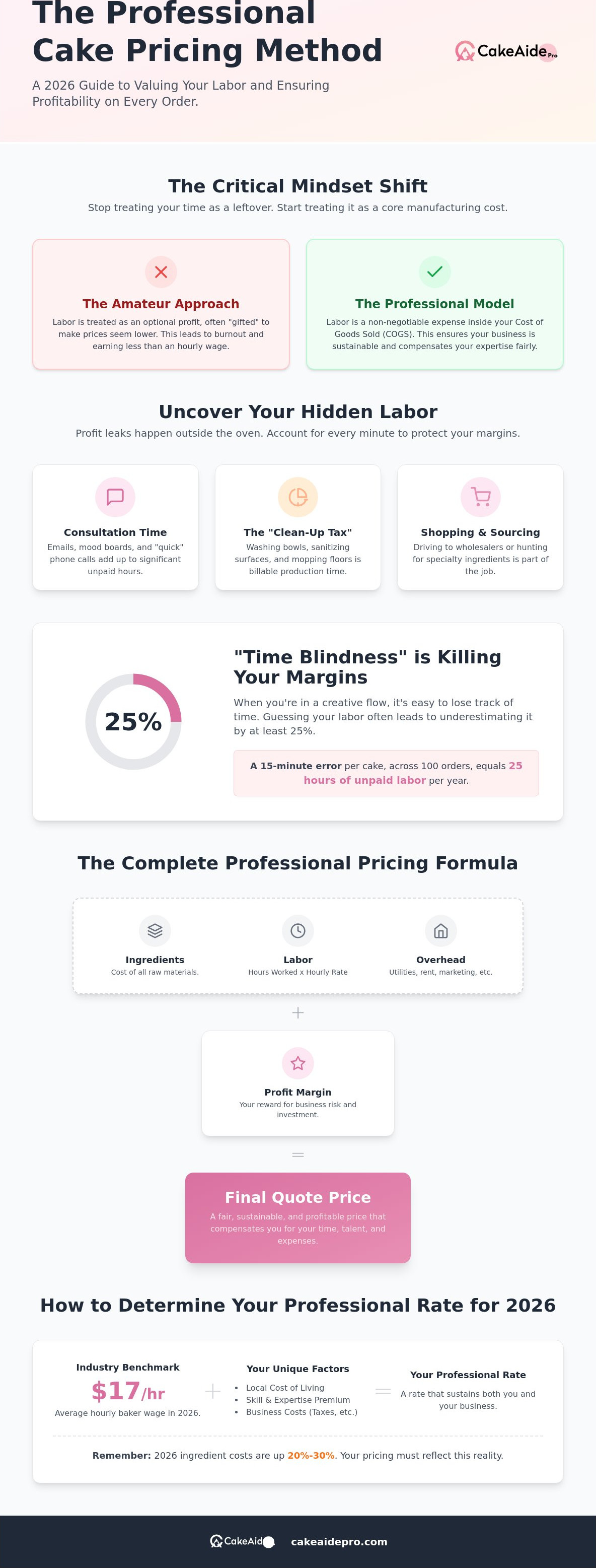
Viewing your time as a luxury rather than a line item is the fastest way to stall your business growth. In the 2026 market, professional bakers are moving away from the "effort" mindset and toward a strict manufacturing model. Labor is a non-negotiable expense that belongs within your Cost of Goods Sold (COGS). If you fail to include it, you aren't just working for free; you are essentially paying your customers to let you bake for them. Understanding Direct Labor Cost is vital because it separates the actual physical work from the business's overall health.
Many creative entrepreneurs struggle with a psychological barrier that leads them to "gift" their time. You might feel that a high price will scare away clients, so you shave off hours from the final quote to make it feel more "reasonable." This is a mistake. Your hourly wage is the payment for your hands-on work, while your profit markup is the reward for the risk and investment of running the business. They are two distinct buckets of money. When you calculate cake prices with labor correctly, you ensure both buckets are filled.
The 2026 economic shift has made manual spreadsheets and "gut feelings" insufficient. With overhead costs like utilities and insurance rising, there is no longer a safety margin to absorb mathematical errors. Precision is the only path to a sustainable, low-stress career. You need a system that tracks reality, not just your best-case scenario.
The Hidden Labor Tasks You are Probably Doing for Free
Profit leaks rarely happen in the oven; they happen at the kitchen sink and the computer desk. You must account for every minute spent on a project to remain profitable. Consider these often-ignored tasks:
- Unpaid consultation time: Every email exchange, mood board creation, and "quick" five-minute phone call adds up to significant hours over a month.
- The "clean-up tax": If it takes an hour to wash the bowls, sanitize the surfaces, and mop the floors after a bake, that hour must be billed.
- Shopping and sourcing: The time spent driving to wholesalers or hunting for specific specialty ingredients is part of the production cycle.
Why "Guessing" Your Time is Killing Your Margins
Creative work often triggers "Time Blindness." This phenomenon occurs when you become so immersed in intricate piping or sugar flower work that three hours pass in what felt like forty minutes. If you guess your time, you are likely underestimating your labor by at least 25%. A small 15-minute error per cake might seem trivial, but across 100 orders a year, that is 25 hours of unpaid labor. Labor cost is the total hours spent on a project multiplied by your professional hourly rate.
When you learn to calculate cake prices with labor with surgical precision, you stop guessing and start growing. You deserve a business that respects your expertise as much as your customers do.
How to Determine Your Professional Hourly Rate
Determining your hourly rate is the most critical decision you will make for your business's financial health. In July 2026, industry benchmarks show that the average hourly wage for a baker in the United States ranges between $14.90 and $17.05. However, as a boutique business owner, you cannot simply adopt a standard employee wage. You are the head of production, the creative director, and the logistics manager. To calculate cake prices with labor that actually sustain your lifestyle, you must start with a "Living Wage plus" strategy. This means taking your local cost of living and adding a premium that reflects your specialized expertise and the wear on your professional equipment.
You also need to account for the hidden expenses that traditional employees don't see. When you consider the true cost of an employee, you realize that your base rate must cover self-employment taxes, health insurance, and retirement contributions. If you only charge what you want to "take home," your business will eventually run out of cash. Professionalism requires looking at the numbers with total honesty. If you are unsure where your current rates stand, you might consider a 7-day free trial of a professional calculator to audit your existing pricing structure.
Skill-Based Tiering for Your Labor Rate
Not every hour in the kitchen is created equal. A logical way to structure your pay is to tier your rates based on the complexity of the task. You might set a standard rate for "production labor," such as baking and basic filling, and a "master-level rate" for intricate sugar work or hand-sculpted figures. This ensures that a complex wedding cake remains profitable even if it takes twenty hours of focused artistry. If a client requests a rush order or a high-stress delivery, your hourly rate should increase to reflect that added pressure on your schedule.
Adjusting for 2026 Inflation and Local Markets
The economic landscape of 2026 is significantly different than it was just a few years ago. Ingredient costs have risen 20% to 30% since 2022, which means your labor must be even more efficient to protect your margins. Research your specific region to see what high-end boutique bakeries are charging for similar work. This isn't about matching their prices; it's about understanding the ceiling in your local market. To protect your time on smaller projects, implement a "Minimum Order" rule. This prevents a single six-inch cake from consuming your entire afternoon for a negligible return. When you calculate cake prices with labor using these professional guardrails, you transform from a hobbyist into a resilient entrepreneur.
Tracking vs. Guessing: The Science of Accurate Time Management
Establishing a professional hourly rate is only half the battle. If you don't know exactly how many hours a project consumes, your rate is essentially a multiplier for a mystery number. Precision in your business requires you to move away from "guesstimates" and toward a data-driven approach. When you calculate cake prices with labor, the accuracy of your time tracking determines whether you actually see that profit at the end of the month. To achieve this level of control, you must treat time management as a repeatable science rather than an afterthought.
Transform your workflow by following these five methodical steps:
- Step 1: Categorize your workflow. Break every project into "Prep," "Bake," "Decorate," and "Admin" to see where your energy is truly going.
- Step 2: Use a dedicated bakery timer. Move beyond the simple kitchen timer and use a tool that can pause and resume as your day shifts.
- Step 3: Log time against specific orders. Ensure every minute is assigned to a client so you can see the true cost of that specific design.
- Step 4: Analyze for "Time Leaks." Review your completed orders to identify tasks that consistently take longer than you anticipated.
- Step 5: Adjust future quotes. Use your real-world data to refine your pricing for the next client, ensuring your optimism doesn't override your profitability.
The Problem with "Phone Stopwatches" and Paper Logs
Relying on a phone stopwatch or a notebook is a recipe for inaccuracy. Life in a home bakery is rarely uninterrupted; kids, deliveries, and phone calls constantly break your focus. If you are using a manual log, it's nearly impossible to retroactively calculate the time spent on a complex three-day project with any degree of certainty. Paper logs are easily misplaced or stained with buttercream, and they never quite make it into the final financial analysis. Digital integration prevents you from "forgetting" to charge for that extra hour of intricate piping, capturing every moment of your expertise automatically.
Using Built-in Timers for Precise Billing
The transition from guessing to tracking allows you to build a comprehensive "Time Library." Over time, you will know with surgical precision that a basic 6-inch round takes 45 minutes of active labor, while a 10-inch version requires 75. This library becomes the foundation of your quoting process, allowing you to provide high-end clients with instant, confident figures. The Cake Aide Pro timer links directly to the Quote Calculator to ensure your tracked hours flow seamlessly into your final pricing. By using these integrated tools, you ensure that as your skills grow, your bank account reflects your increased efficiency. When you calculate cake prices with labor using actual data, you finally gain the work-life balance you deserve.
The Complete Cake Pricing Formula: Labor Meets Logic
Switching to a logic-based formula is the only way to protect your business from the "labor leak" that often drains home bakeries. The old "Rule of Three," which suggests simply multiplying your ingredient costs by three, is a dangerous relic. If you rely on it for a custom order, you are gambling that the markup on flour and sugar will magically cover ten hours of intricate sugar work. It rarely does. To calculate cake prices with labor that actually reflect your worth, you must adopt the 2026 Pro Formula: (Ingredients + Labor + Overhead) x Profit Margin = Base Price.
Calculating your overhead is the step most hobbyists skip, yet it is the foundation of a professional enterprise. Start by totaling your monthly fixed costs, including kitchen rent, insurance, website hosting, and your Cake Aide Pro subscription. Divide this total by the average number of orders you fulfill each month. This gives you a specific dollar amount to add to every quote, ensuring your electricity and marketing are never paid out of your own pocket. If a project involves high-stakes structural engineering or hand-painted details, apply a "Difficulty Multiplier" to your labor rate to account for the intense focus required.
To see how these numbers look for your own business without the manual math, start your 7-day free trial and let the Quote Calculator handle the heavy lifting.
Calculating Total Production Time (Prep to Cleanup)
Precision requires you to track every minute from the moment you start prepping your pans to the final wipe of the counter. Don't ignore oven time; while it is passive labor, that cake is still occupying your workspace and consuming energy. You must also bill for the physical toll of delivery and setup. Carrying a three-tier wedding cake into a venue and spenting forty minutes on floral placement is high-value labor that belongs in your quote. Creating a standardized "Time Template" for your most popular sizes will help you quote faster and more accurately.
Profit Margin vs. Labor Wage: Why You Need Both
It's vital to remember that your labor wage is your salary, but the profit margin is the money your business earns. Labor pays for your time today; profit pays for your new oven tomorrow. For a boutique bakery, a sustainable profit margin typically sits between 20% and 35%. This "Reinvestment Fund" allows you to scale from a home kitchen to a professional studio without taking on personal debt. When you calculate cake prices with labor and profit as separate entities, you gain the financial clarity needed to grow a resilient, long-term brand.
Streamlining Your Profits with Cake Aide Pro
Transitioning from a manual spreadsheet to a dedicated digital tool is the final step in securing your business's future. While a basic Google Sheet might track costs, it lacks the integrated intelligence needed to manage a modern boutique bakery. Cake Aide Pro acts as your silent business partner, handling the complex math of the 2026 formula in seconds. When you use the Quote Calculator, you aren't just adding numbers. You are applying a consistent, professional logic to every inquiry that comes through your door. This automation ensures you never accidentally skip your overhead or underestimate your time when you calculate cake prices with labor.
One of the most common profit killers is "design creep," where a client requests small changes that slowly erode your margins. By centralizing client photos and order details within the app, you can track the exact complexity of a design from the initial quote to the final bake. If a client sends a new inspiration photo that requires three additional hours of piping, you will have the data right in front of you to adjust the price accordingly. Additionally, the app automates your shopping lists based on your recipes, saving you hours of manual admin labor every week. When tax season arrives, the CSV export feature allows you to hand over clean, professional labor records to your accountant with a single click.
From Kitchen Chaos to Professional Workflow
Success in the baking industry requires more than just great recipes; it requires a streamlined workflow that respects your time. Managing your orders directly from your phone allows you to provide professional quotes on the go, ensuring you never lose a lead to a faster competitor. You can also set smart client reminders for upcoming birthdays and anniversaries, helping you secure repeat labor without the stress of constant marketing. This level of organization provides a sense of calm reliability. You can finally step into your kitchen with the peace of mind that every second you spend at the bench is accounted for and paid for.
Try the 7-Day Free Trial: Your Business Reset
If you feel like your current pricing is a game of guesswork, it is time for a professional audit. Use your next three orders to test the precision of the Cake Aide Pro timer and Quote Calculator. Compare your "old" estimated price to the "software-calculated" price to see exactly where your labor leaks are happening. Most bakers find they have been undercharging by 15% to 20% simply by missing hidden tasks like cleanup and consultations. Taking this step is about more than just numbers; it is about valuing your artistry and your life. Professionalize your pricing with a 7-Day Free Trial of Cake Aide Pro and discover what it feels like to run a truly profitable creative business.
Taking Control of Your Professional Worth
You now have the structural foundation to transform your kitchen from a hobby space into a high-performing boutique studio. By acknowledging that labor is a direct cost rather than a variable afterthought, you protect your most valuable asset: your time. Precision tracking and a logic-based formula are the only ways to stay resilient against rising 2026 costs. When you calculate cake prices with labor using these professional standards, you eliminate the anxiety of quoting and replace it with the confidence of a seasoned entrepreneur.
Cake Aide Pro was designed by industry professionals specifically to bridge the gap between artisanal talent and business efficiency. Featuring a built-in precision timer and quote calculator, our platform is trusted by home bakers making the successful move from kitchen to boutique. You don't have to navigate the complex math of profitability alone. Start your 7-day free trial and master your cake margins today.
Your talent deserves a business that supports your life and rewards your expertise. It is time to stop guessing and start growing with total clarity.
Frequently Asked Questions
How much should I charge per hour for cake decorating in 2026?
You should aim for a baseline rate that reflects current industry standards while covering your specific expertise. In July 2026, the average hourly wage for a baker in the United States ranges between $14.90 and $17.05. As a business owner, your rate should sit at the higher end of this scale, or even above it, to account for your specialized skills and the administrative responsibilities of running a boutique studio.
Should I charge for the time the cake is actually in the oven?
Yes, you should include oven time in your labor calculation, though some bakers choose to bill this at a lower "passive" rate. While the cake is baking, your kitchen is occupied and your production capacity is limited. Charging for this time ensures that your overhead and equipment usage are fully supported, even when you aren't actively decorating at the bench.
How do I explain my labor costs to a customer who thinks my cakes are too expensive?
Focus your explanation on the value of artisanal craftsmanship rather than defending your prices. You can explain that your quotes reflect the hours of dedicated focus required for custom designs and the use of premium ingredients. Professional quotes that break down the complexity of the project help clients understand that they are paying for a high-end service, not just a dessert.
Do I need to track the time I spend answering client emails?
Tracking administrative time is essential for maintaining your profit margins. Emails, phone calls, and mood board creations are all direct labor tasks associated with a specific order. If you don't account for these hours, you are essentially gifting your professional consultation services for free, which can lead to significant financial leaks over the course of a year.
What is the difference between markup and profit margin in a bakery?
Markup is the percentage you add to your total costs to reach a selling price, while profit margin is the percentage of the final sale that remains after all expenses are paid. For example, if a cake costs $100 to make and you sell it for $150, your markup is 50%, but your profit margin is 33.3%. Understanding this distinction is vital for long-term financial planning.
How do I calculate labor for a cake that takes three days to complete?
The most accurate method is to use a dedicated timer to log every session across the production period. This allows you to calculate cake prices with labor by capturing every touchpoint, from the initial bake on day one to the final detail on day three. Digital logs prevent you from losing track of the small, ten-minute tasks that often go unbilled in complex projects.
Can I use a simple "price per serving" model instead of calculating labor?
Price per serving is a helpful benchmark for basic cakes, but it is often insufficient for custom artistry. A simple tiered cake takes significantly less time than a hand-sculpted character cake, even if they serve the same number of people. Using an hourly labor model ensures that the specific complexity of a design is reflected in the final price, protecting your income on difficult orders.
Is it better to have a flat labor fee or an hourly rate?
An hourly rate is generally better for custom work because it protects you from "design creep" and unexpected complications. A flat fee can work for signature designs that you have mastered and timed repeatedly; however, custom orders vary too much to be covered by a single flat number. Charging hourly ensures you are paid for the actual work performed, regardless of the project's unique challenges.